|
Black Skimmers ͏ ͏ ͏ ͏ ͏ ͏ ͏ ͏ ͏ ͏ ͏ ͏ ͏ ͏ ͏ ͏ ͏ ͏ ͏ ͏ ͏ ͏ ͏ ͏ ͏ ͏ ͏ ͏ ͏ ͏ ͏ ͏ ͏ ͏ ͏ ͏ ͏ ͏ ͏ ͏ ͏ ͏ ͏ ͏ ͏ ͏ ͏ ͏ ͏ ͏ ͏ ͏ ͏ ͏ ͏ ͏ ͏ ͏ ͏ ͏ ͏ ͏ ͏ ͏ ͏ ͏ ͏ ͏ ͏ ͏ ͏ ͏ ͏ ͏ ͏ ͏ ͏ ͏ ͏ ͏ ͏ ͏ ͏ ͏ ͏ ͏ ͏ ͏ ͏ ͏ ͏ ͏ ͏ ͏ ͏ ͏ ͏ ͏ ͏ ͏ ͏ ͏ ͏ ͏ ͏ ͏ ͏ ͏ ͏ ͏ ͏ ͏ ͏ ͏ ͏ ͏ ͏ ͏ ͏ ͏ ͏ ͏ ͏ ͏ ͏ ͏ ͏ ͏ ͏ ͏ ͏ ͏ ͏ ͏ ͏ ͏ ͏ ͏ ͏ ͏ ͏ ͏ ͏ ͏ ͏ ͏ ͏ ͏ ͏ ͏ ͏ ͏ ͏ ͏ ͏ ͏ ͏ ͏ ͏ ͏ ͏ ͏ ͏ ͏ ͏ ͏ ͏ ͏ ͏ ͏ ͏ ͏ ͏ ͏ ͏ ͏ ͏ ͏ ͏ ͏ ͏ ͏ ͏ ͏ ͏ ͏ ͏ ͏ ͏ ͏ ͏ ͏ ͏ ͏ ͏ ͏ ͏ ͏ ͏ ͏ ͏ ͏ ͏ ͏ ͏ ͏ ͏ ͏ ͏ ͏ ͏ ͏ ͏ ͏ ͏ ͏ ͏ ͏ ͏ ͏ ͏ ͏ ͏ ͏ ͏ ͏ ͏ ͏ ͏ ͏ ͏ ͏ ͏ ͏ ͏ ͏ ͏ ͏ ͏ ͏ ͏ ͏ ͏ ͏ ͏ ͏ ͏ ͏ ͏ ͏ ͏ ͏ ͏ ͏ ͏
WingspanSt. Petersburg Audubon Society’s Monthly Newsletter July-August 2025 Spotlight | Black Skimmers
|
|
The Black Skimmer, Rynchops Niger, the strikingly beautiful, graceful seabird with black and white plumage, black and red bill, orange legs and feet, and a wingspan approaching four feet, joins terns and gulls in the Family Laridae, Order Charidriiformes. The common name derives from its unique manner of foraging by touch, skimming a water’s surface with its elongated mandible and quickly closing its jaw when a small fish is encountered. Hunting for fish, either freshwater or saltwater, in low light situations is also facilitated by its vertical pupils, which can narrow to slits to reduce glare effect from bright sunlight. The Atlantic, Gulf, and California Coasts are home to an estimated 93,000-101,000 of the North American subspecies, some who live there year-round as residents and others who winter in Central and South America. Seasonal nesting on the Beach
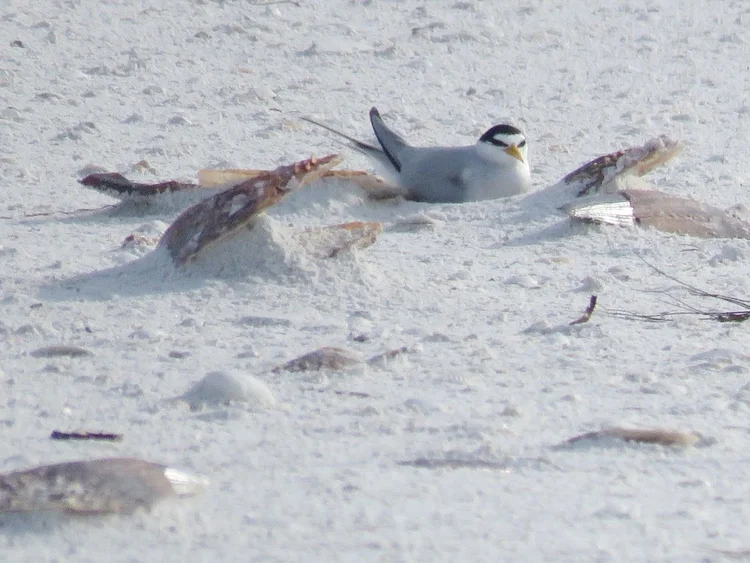
Black Skimmers are colonial nesters, and our Southwest Florida region has been host to colonies at St Pete Beach, Redington Shores, Egmont Key, Sarasota’s Lido Key. In April-May of each year, the birds begin to gather, pair off, and initiate courtship behavior, during which there may be a bit of parading around, some showy, tandem aerial ballets, and lots of kicking up sand to form scrapes, one of which will become the official nest. Just before mating, the male presents the female with a fish, and copulation ensues if the fish is accepted. When the first eggs of the colony are laid, ever-vigilant monitors from Audubon Florida post the nesting area with stakes, strings, and neon ribbons, following guidelines to ensure safety and efficacy. Each Black Skimmer pair produces 3-5 cream-colored, spotted eggs, which are incubated alternately by both male and female over a span of 23-25 days. The tiny, down-covered chicks can stand soon after hatching and are supervised and fed by parents until they fledge at 28-30 days. Eventually they separate from parents and disperse to new locations, usually along the Gulf Coast but sometimes in other Florida locales. This year, a bird hatched and banded on St Pete Beach in 2023 was resighted in Anastasia Island State Park, St Augustine Beach. Success is a Cooperative Effort
During this whole process, it is fascinating to observe interactions between mates, the sharing of incubation and foraging duties, and the sweet post-hatching family scenes that include chicks cuddling under adult wings, teetering and then running about, always eagerly awaiting to eat impossibly-big morsels brought by parents. The adults are fiercely protective of the colony, their mates, and their young, using individual dive-bombing or group-mobbing maneuvers, making their distinctive kak-kak-kak calls to warn potential predators to keep their distance. It is a rocky road, though, fraught with persistent predating gulls and crows, who hunt in groups for eggs and small chicks, and disturbances by humans, their vehicles and their recreational activities, unleashed dogs, and storms, all of which can lead to stress-related morbidity and even infanticide. Because of these challenges as well as habitat loss from beach development and climate change, Black Skimmers have experienced a population decline of up to 4% per year, according to the North American Breeding Bird Survey, and are considered a Threatened Species in the state of Florida. Nonetheless, they have a considerable fan club, volunteer Bird Stewards trained by local Audubon Societies, Audubon Florida, and the Florida Shorebird Alliance. These Skimmer champions devote hours on the hot beaches promoting awareness of the nesting season, which brings forth a vulnerable new generation of chicks, sharing information about the species, and guiding people to embrace the sensible and compassionate ethic of sharing the shore. If you ask the Stewards, they are likely to say “It is our incredible privilege!” Thank you to our Pinellas County Bird Stewards and their leaders! Kara Durda | Shorebird Program Manager Sydney Brazzle | South Pinellas Anchor Steward Trevor Clair | Mid-Pinellas Anchor Steward Dr. Elizabeth Forys | Eckerd College Environmental Studies professor and Director of Pinellas and Sarasota Black Skimmer Banding Project
Hannah Brownlee, Joni Snellgrove, Kayla Ford, Brodie Solomon, Tammy Capitani, Beth Reynolds, Tina Crevello, Emily Olson, Andrea Andersen, Louisa Tighe, Kim Taylor, Sarah Plesich, Robin Perlman, Deb DelSole, Hayley Grice, Connie Walsh, Marilyn Beck, Ed Calcaterra, Darlene Westberg, Jake Mandell, John Carreiro, Rhianna Tanner, Taylor Smith, Etienne Pracht, Beth Wilt, Park Chapman, Yeshvant Gill, Mikkel Paulson, Isabelle Wood, Lonnie Jones, Lisa Reich, Ginger Goepper, Donna Sperber, Mandy Eyrich, Suzanne Joyce, Laurie Allread, Marilyn Beck, Louise Bergman, Jean Campbell, Jan Draheim, Eve Waterman, Jo Applefield, Mary Wintermute, Greg Smith, Trevor Clare, Mary Alice Anderson, Saray Galloway, Susan and Wells Benson, Emily Robinson, Megan Foster and Regi Barosa, Brooklyn Boley, Kara, Leo Dutkewych, Julie Chamberlain, Alan Shapiro, Suzanne Joyce, Carole Devillers, Margaret Santangelo, Tess Augusta, Gabrielle Sconzo, Hanna Mosher. Zoo Tampa Black Skimmer Banding Project Black Skimmer Chick Aging Guide Florida Guidelines for Posting Shorebird and Seabird Sites Black Skimmer Courtship and Nesting Guide Coastal Stewardship in Florida References | Florida Shorebird Alliance, Cornell Lab of Ornithology, All About Birds, American Bird Conservancy, Florida Fish and Wildlife Conservation Commission
|
|
|
|
Protecting the colony _______________ |
|
|
|
|
|
|
PURPLE MARTIN PROJECT AT CRESCENT LAKEIf you’ve been by Crescent Lake lately, you may have spotted a new Purple Martin house near the baseball field! Installed in early 2025, it was a gift from the St. Pete Audubon Society, thanks to the efforts of John Ficken, Pete Plage, and Mark Frohman. With help from the City and our team at Stewards of Our Urban Lakes, we found the perfect spot—open, unobstructed, and already popular with Martins! The birds moved in quickly, and by spring, every compartment was occupied. A new sign, sponsored by Audubon, was just installed to help folks learn more. Big thanks to everyone who made this project fly! Jim Bays | President, Stewards of Our Urban Lakes Inc. |
|
|
|
MAY FIELD TRIP REFLECTIONS
Boyd Hill 1st Saturday | May
Leader Paul Waton kicked off the SPAS First Saturday Bird Walk at Boyd Hill Nature Preserve, continuing a tradition that Ron Smith initiated in 1989. Paul reported a good turn-out of people (33) and birds (37 species), including some migratory favorites: Black-throated Blue Warbler, Cape May Warbler, Blackpoll Warbler, American Redstart, and Northern Waterthrush. Ft DeSoto ShorebirdsEleven of us met at North Beach, Fort De Soto for the "Shorebirds in Breeding Plumage" walk. We were fortunate to view a flock of 180 Red Knot feeding on coquinas along the beach, many in bright breeding (alternate) plumage. Other shorebirds in striking breeding colors included Sanderling, Dunlin, Black-bellied Plover and Ruddy Turnstone. A total of 15 shorebird species were encountered including Piping Plover, Wilson's Plover and Whimbrel. Another highlight, among the approximately 40 species seen, was a Gull-billed Tern swooping low over the mudflats in pursuit of insects.
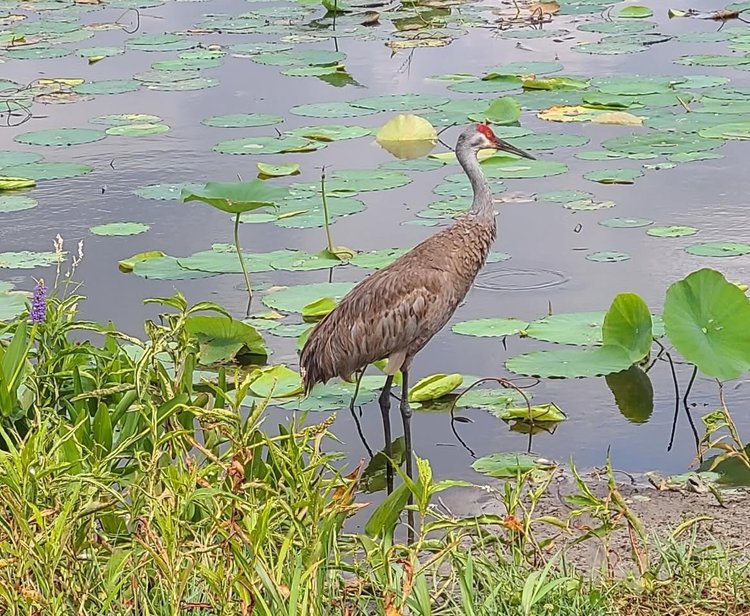
Peter Plage, Leader Circle B Bar PreserveWe had a fabulous day on the tram tour on May 9th! We had a total of 14 participants! The tour guide was very knowledgeable, affable, and accommodating. Since we registered as a group, we had the tram to ourselves! Very comfy! I recorded a total of 25 species. I only record what I see, and do not record what I hear, so others may have a few more on their list. We saw Black-bellied Whistling Duck, Common Ground Dove, Common Gallinule, Limpkin, Anhinga, White Ibis, Glossy Ibis, Roseate Spoonbill, Little Blue Heron, Tricolored Heron, Snowy Egret, Green Heron, Cattle Egret, Great Egret, Great Blue Heron, Turkey vulture, Osprey, Swallow-tailed Kite, Bald Eagle, Red-shouldered Hawk, Red-winged Blackbird, Boat-tailed Grackle and Northern Cardinal. The bird of the day was a Sandhill Crane!
Everyone said that this was a wonderful tour and would do it again. I think that next year, we will do it in April, during migration.
Francesca de Cosmo, Field Trip Coordinator
|
Boyd Hill 1st Saturday Field TripsJulyLeader: Paul WatonSaturday, July 5, 2025
8:00AM-10:00AM AugustLeader: Peter PlageSaturday, August 2, 2025
8:00AM-10:00AM Location: Boyd Hill Nature Preserve
1101Country Club Way S., St Petersburg, FL 33705
Walk is on dirt trails and boardwalks
Meet in front of the Nature Center at 7:45am; walk will start at 8:00am What to Bring: Hat, Binoculars, Insect repellant, Sunscreen (although portions will have shade). Water is available on some of the trails. Public Restrooms: Located in the Nature Center St Petersburg Audubon Society plans to continue Ron Smith’s tradition of organizing a monthly Boyd Hill bird walk at 8AM on the first Saturday of the month. Current leaders include Peter Plage, John Ficken, and Paul Waton. If you are a bird enthusiast interested in helping to lead a walk at Boyd Hill or another St Pete location, please contact:
Francesca Di Cosmo, fieldtrips@stpeteaudubon.org.
An encouraging note to all potential leaders:
You Have What It Takes To Lead Bird Outings, from Audubon Magazine _______________Annual Members Meeting, Potluck & Aviary TourTuesday, September 16, 2025
6:30 PM 8:00 PM Location: Boyd Hill Nature Preserve Nature Center Classroom
1101Country Club Way S., St Petersburg, FL 33705 Please pre-register! We need to cap this at 50 for the room size. Closer to the time of the event, we will send follow up emails to ask if you are bringing food, etc. St. Pete Audubon: September Annual Members' Meeting _______________From Audubon
|
|
Fort De Soto Highlights Nature’s Resilience After Hurricanes
Pinellas County Anchor Steward Sydney Brazzle, writing for Audubon Florida, chronicles the aftermath of Hurricanes Helene and Milton at Ft DeSoto, where much of the landscape changed and new patterns of avian behavior and nesting have emerged. Audubon’s Plants for Birds Program
Learn how Audubon centers and chapters nationwide are providing education and implementing programs to support and expand native planting and natural habitats for birds and other wildlife. Audubon Florida Assembly
Registration opens soon for Audubon Assembly, Florida’s premier conservation gathering, where grassroots leaders from around the state join Audubon’s professional staff and partners to expand their networks and increase knowledge and skills to protect Florida’s precious natural resources. The two-day event will take place in Central Florida on October 16-18. Little Fish are the Beating Heart of an Ocean
Just in time for World Oceans Day, Jun 8, Reps. Debbie Dingell (MI) and Brian Mast (FL) reintroduced the Forage Fish Conservation Act in the U.S. House. Celebrating 125 Years of Audubon in Florida Formed to bring wading birds back from the brink of extinction, Audubon has been working for more than a century to protect birds because we know that the things birds rely on—healthy habitats, clean air, abundant fresh water, resilient coastlines—are the same things that people and other wildlife need to thrive. Birds are symbols and sentinels to measure our success, and they inspire us to work collaboratively and expansively throughout the hemisphere. In simplest terms, “what’s good for birds is good for the Earth.”
If you’re in the Jacksonville area, you can enjoy the “125 Years of Audubon in Florida" exhibit at the Jacksonville Airport Sky Gallery from July 4 through December 15, 2025. A similar exhibit will be featured in the Lyonia Environmental Center in Deltona from July 10 to October 10. In the NewsFlorida Forever Funding a fraction of proposal
Despite overwhelming support from their constituents, Florida legislators chose not to fund this very popular program at the level that it warrants. Use this form to let them know you are disappointed that only $3 million of the proposed $100 million was appropriated. _______________
|
|

|
|
St. Petersburg Audubon SocietyFounded November 25, 1909 To save the beautiful plumaged Florida birds from extinction by the plume hunters of the millinery-feather industry, and prove the economic value of birds to agriculture and to the welfare of man. The first meeting was held at the Belmont Hotel on December 14, 1909. |
|
|
|
|
A fascinating and detailed account published in commemoration of the 100th anniversary of SPAS in 2009 now appears on the SPAS website. If anyone would like to work on updating the history from 2009 to present, please contact Beth Forys, president@stpeteaudubon.org ************ A member survey was conducted in June of this year, the results of which are now available through this link: June 2025 Member Survey Results
|
|
|
|