|
Shorebird Nesting II, Purple Martins ͏ ͏ ͏ ͏ ͏ ͏ ͏ ͏ ͏ ͏ ͏ ͏ ͏ ͏ ͏ ͏ ͏ ͏ ͏ ͏ ͏ ͏ ͏ ͏ ͏ ͏ ͏ ͏ ͏ ͏ ͏ ͏ ͏ ͏ ͏ ͏ ͏ ͏ ͏ ͏ ͏ ͏ ͏ ͏ ͏ ͏ ͏ ͏ ͏ ͏ ͏ ͏ ͏ ͏ ͏ ͏ ͏ ͏ ͏ ͏ ͏ ͏ ͏ ͏ ͏ ͏ ͏ ͏ ͏ ͏ ͏ ͏ ͏ ͏ ͏ ͏ ͏ ͏ ͏ ͏ ͏ ͏ ͏ ͏ ͏ ͏ ͏ ͏ ͏ ͏ ͏ ͏ ͏ ͏ ͏ ͏ ͏ ͏ ͏ ͏ ͏ ͏ ͏ ͏ ͏ ͏ ͏ ͏ ͏ ͏ ͏ ͏ ͏ ͏ ͏ ͏ ͏ ͏ ͏ ͏ ͏ ͏ ͏ ͏ ͏ ͏ ͏ ͏ ͏ ͏ ͏ ͏ ͏ ͏ ͏ ͏ ͏ ͏ ͏ ͏ ͏ ͏ ͏ ͏ ͏ ͏ ͏ ͏ ͏ ͏ ͏ ͏ ͏ ͏ ͏ ͏ ͏ ͏ ͏ ͏ ͏ ͏ ͏ ͏ ͏ ͏ ͏ ͏ ͏ ͏ ͏ ͏ ͏ ͏ ͏ ͏ ͏ ͏ ͏ ͏ ͏ ͏ ͏ ͏ ͏ ͏ ͏ ͏ ͏ ͏ ͏ ͏ ͏ ͏ ͏ ͏ ͏ ͏ ͏ ͏ ͏ ͏ ͏ ͏ ͏ ͏ ͏ ͏ ͏ ͏ ͏ ͏ ͏ ͏ ͏ ͏ ͏ ͏ ͏ ͏ ͏ ͏ ͏ ͏ ͏ ͏ ͏ ͏ ͏ ͏ ͏ ͏ ͏ ͏ ͏ ͏ ͏ ͏ ͏ ͏ ͏ ͏ ͏ ͏ ͏ ͏ ͏ ͏ ͏ ͏ ͏ ͏ ͏ ͏ ͏
WingspanSt. Petersburg Audubon Society’s Monthly NewsletterSummer 2026Shorebird Nesting|Part II
|
|
|
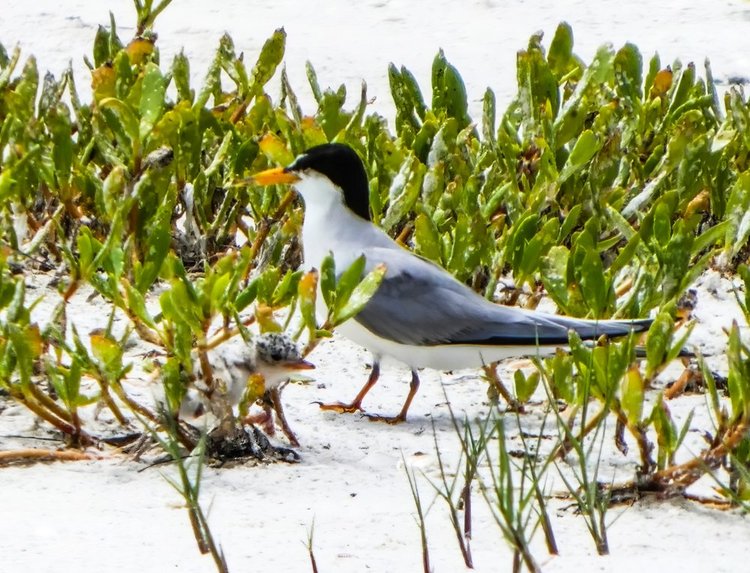
Fort DeSoto’s Outback Key experienced a second rogue wave in early May, but the plucky Least Terns seem determined to maintain a successful colony, with 34 nests until the 10th of May, according to environmentalist and longtime Florida Shorebird Alliance volunteer Lorraine Margeson. This number fell to 24 after a Yellow-crowned Night Heron took advantage of an easy meal, though this predator subsequently suffered quite a beating from the Least Terns’ defensive mobbing. Circling gulls and crows have also been kept at bay by the cooperative practices of these colonial nesters.
If all of this were not enough, over the new moon weekend of May 15-17, Ft DeSoto experienced king tides, brought about by the combined gravitational pulls of the Earth, moon, and sun in alignment while the moon is at its perigee, closest to Earth. The resulting elevated coastal water levels washed away all but 5 of the Least Tern nests. Within days, pairs got busy courting, mating, and scraping, and new nests appeared daily. The first chick just arrived, May 31st! Stay tuned!
Multiple solitary-nesting Wilson’s Plover pairs have also chosen this area to breed. Two chicks hatched in early May, two more by mid-May, and an additional single chick on May 21st. There are at least two more active nests at Outback Key, and East Beach’s Wilson’s Plover pair produced 2 eggs and 2 chicks, 1 of which survived.
Beloved American Oystercatchers AE and Archie did not return to Outback Key after losing their nest to the rogue wave. Instead, they chose another favored locale, Shell Key, to create a new nest, and they are now incubating three eggs! There is another American Oystercatcher nest in the North Beach Sanctuary and several potential Oystercatcher pairs frequenting the Ft DeSoto beaches.
Photos|Wilson’s Plover chick, Least Tern with chick|Lorraine Margeson |
|
|
|
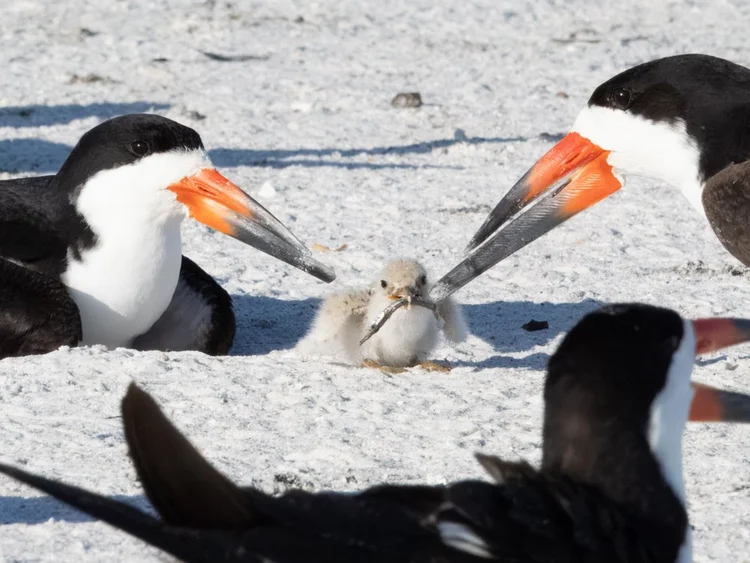
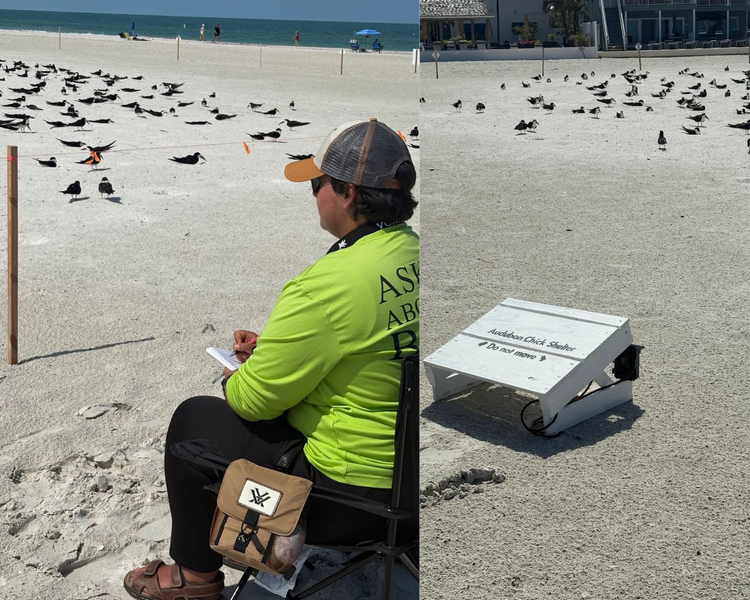
Black Skimmer colonies coalesced on St Pete Beach and Redington Shores during late April and egg-laying began during the first week of May. Mid-Pinellas Anchor Steward Amanda Janulionis reported 27 active nests at St Pete Beach and 10 at Redington Shores on May 14th. However, as if April’s attempted sabotage by a mothball dump on St Pete Beach were not enough, there has been evidence of human encroachment into the St Pete Beach colony, causing the abandonment of one nest and the loss of at least one egg.
Placement of an additional camera was planned in order to enhance monitoring. The use of “crow effigies” is also being implemented in response to recent harassment of the colony by Fish Crows.
By May 24th, 176 active nests were observed by veteran Black Skimmer scholar Beth Forys. The first chick hatched on May 25th at Redington Shores and on May 28 at St Pete Beach. Photo | Donna Sperber |
|
|
|
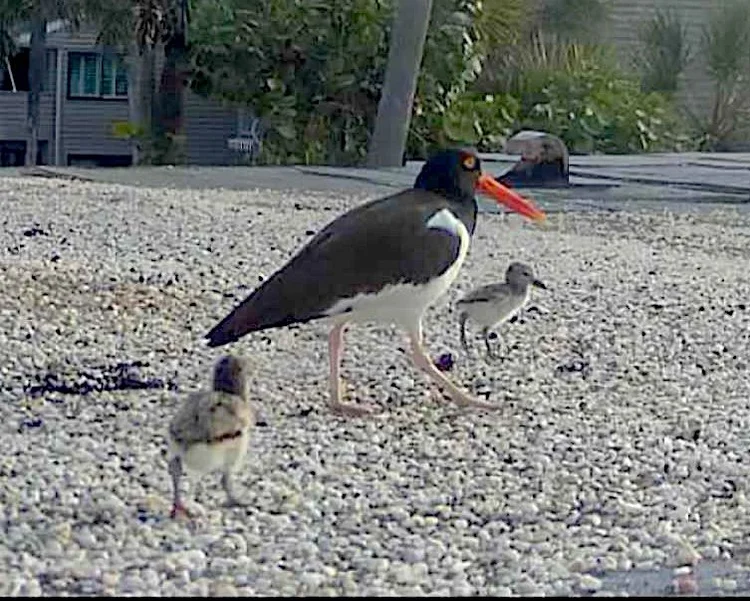
Threatened shorebirds, including American Oystercatchers and Least Terns, nest on gravel rooftops as well as on the beaches. These rooftop Oystercatcher chicks were 2 weeks old as of Mother’s Day weekend.
Photo|Abby McKay, Audubon Florida
Volunteers will be needed throughout the summer to help all of these threatened birds safeguard their eggs and nurture their newly-hatched young through fledging and beyond. Stewarding is fun, interesting, and very rewarding!
Become a Beach Steward! _________________________ Student Scientists |
|
|
|
Remember Rowan Byrne, the USF student who, for his senior honors thesis project, analyzed the effects of local beach renourishment on the quality of sand, the invertebrates it supports, and subsequent foraging outcomes for Sanderlings? (Wingspan May 2026). Here he is, out at the St Pete Beach Black Skimmer colony, stewarding and collecting data for his Gabe Vargo Grant research on the comparative incubating behaviors of male versus female Skimmers. He and supervisor Beth Forys have installed two motion-triggered cameras to monitor night-time intrusions and possibly provide additional information for the study. |
|
|
|
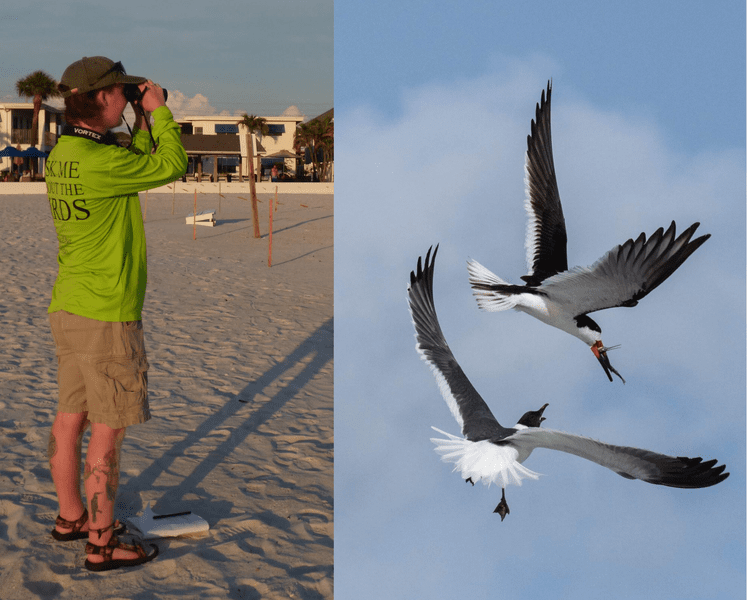
Gale Raichart is also out on the beaches, investigating kleptoparasitic behavior, also known as piracy, by Laughing Gulls on Black Skimmers. This is particularly problematic when adults are bringing fish back to the colony to feed their chicks. Gale’s research is investigating the influence of chick age on frequency of kleptoparasitism and the success rate of piracy attempts by the gulls.
Skimmer photo|Karen Catbird Thank you to everyone who has donated to St. Pete Audubon or is a member. You are making this stewardship and research possible! _________________________ Field Trips |
|
|
|
Boyd Hill First Saturday Bird Walks
June
Leader: Peter PlageSaturday, June 6, 2026 July
Leader: JoAnna ClaytonSaturday, July 4, 2026 August
Co-leaders:
Paul Waton, Susan Ladwig, & Donna SperberSaturday, August 1, 2026 8AM-10AM Location
Boyd Hill Nature Preserve
1101 Country Club Way S
St Petersburg, FL 33705 Meet in front of the Nature Center at 7:45AM; walk will start at 8:00AM.
Walk is on dirt trails and boardwalks.
What to Bring: Hat, binoculars, insect repellant, sunscreen, water
Public Restrooms: Located in the Nature Center
If you are a bird enthusiast interested in helping to lead a Boyd Hill walk, please contact Paul Waton pvwaton@gmail.com An encouraging note to all potential leaders:
Audubon Spring, 2025: You Have What It Takes To Lead Bird Outings _________________________ |
|
|
|
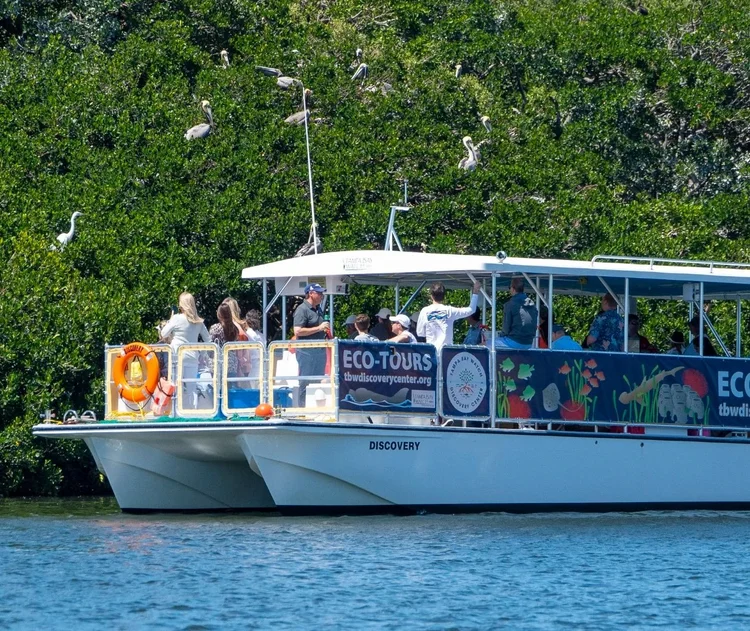
Sunset Boat Trip | Coffee Pot Bayou Bird IslandSaturday, July 18, 2026
6:30-8:00 PM
Location: The trip will depart from the St. Pete Pier via the Tampa Bay Watch’s vessel Discovery. The cost is $30/person. Proceeds will benefit Tampa and St Pete Audubon Societies (based on the number of passengers from each area). Boat space is limited; reserve now! Contact Ann Paul annpaul26@gmail.com
________________________
|
|
|
|
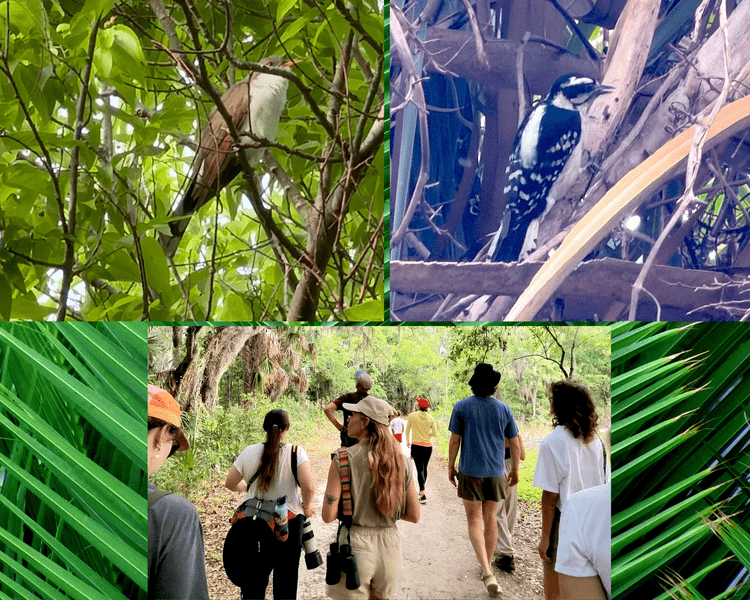
Here is Pete Plage, who, along with Paul Waton, investigated Boyd Hill’s many wooded trails with a mixed band from beginner birders to pros. Some highlights of the May 2nd walk included a pair of Yellow-billed Cuckoos, Magnificent Frigatebirds, Purple Martins, Downy Woodpecker, Royal Terns, Green Herons, Northern Parula, and a resident raccoon. _________________________ |
|
|
|
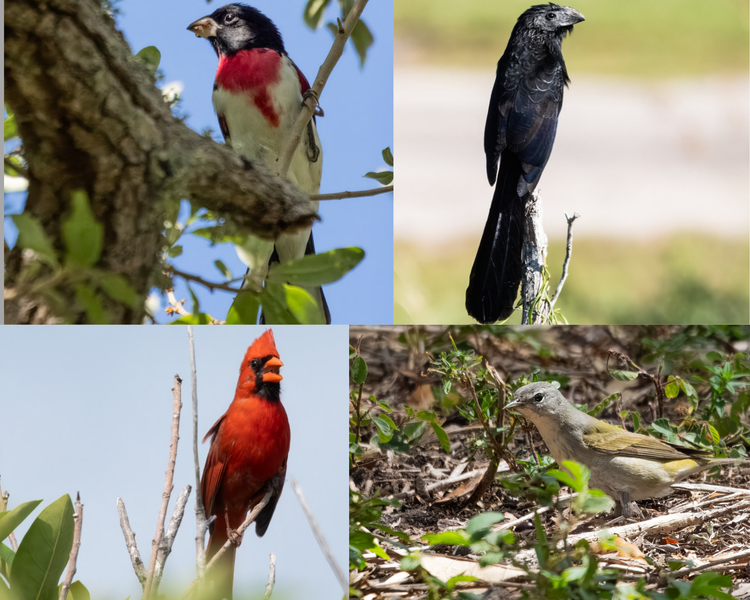
Pete Plage led a marathon 3-hour field trip at Ft DeSoto on Tuesday, May 5th, covering areas around Bay Pier, East Beach, and the fort. The Nandays were particularly entertaining as they investigated cavities in snags. An interesting group of three Loggerhead Shrikes appeared to be building a nest amongst dead twigs, and a pair of Gray Kingbirds, flycatchers known to nest in the park, perched together briefly. Migrant highlights were Rose-breasted Grosbeaks and a pair of Tennessee Warblers, one of which dropped to the ground for a few moments, allowing for a good view. We saw close to 30 species, including the Groove-Billed and Smooth-Billed Anis, Bald Eagles, male and female Indigo Buntings, Royal Terns, and a Northern Cardinal whose song was as striking as his brilliant color. _________________________ |
|
|
|
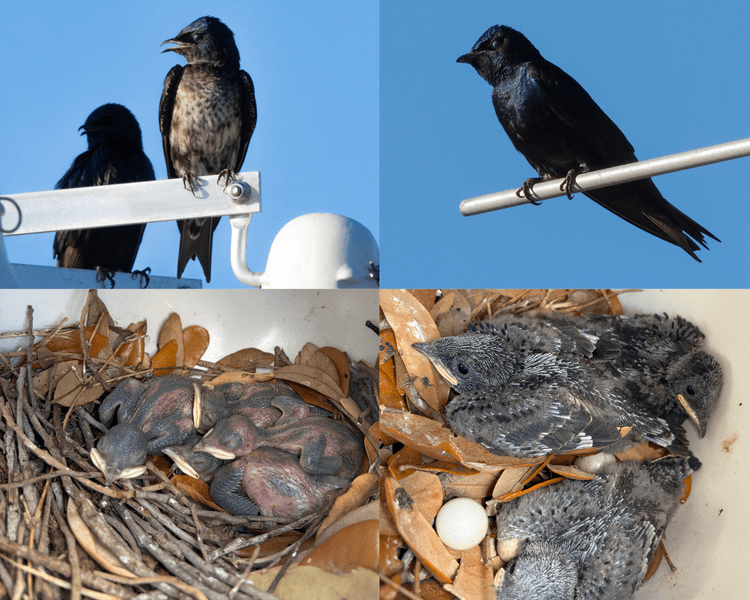
Purple Martin enthusiast Mark Frohman, along with Pete Plage, Jim Bays, and Abby McKay, have been monitoring local Purple Martins in their man-made nesting abodes at Crescent Lake, Lake Maggiore, and Mirror Lake. At Crescent Lake, as of the end of May, about 46 fledglings, which are similar in appearance to adult females, are now receiving flying and hunting lessons from their parents. Throughout the summer, Purple Martin families join together in large staging roosts to feed and socialize before their long migratory journey to South America, where they over-winter through at least January of the following year.
Learn more!| Purple Martin Conservation Association
Chick photos | Abby McKay _________________________ |
|
|
|
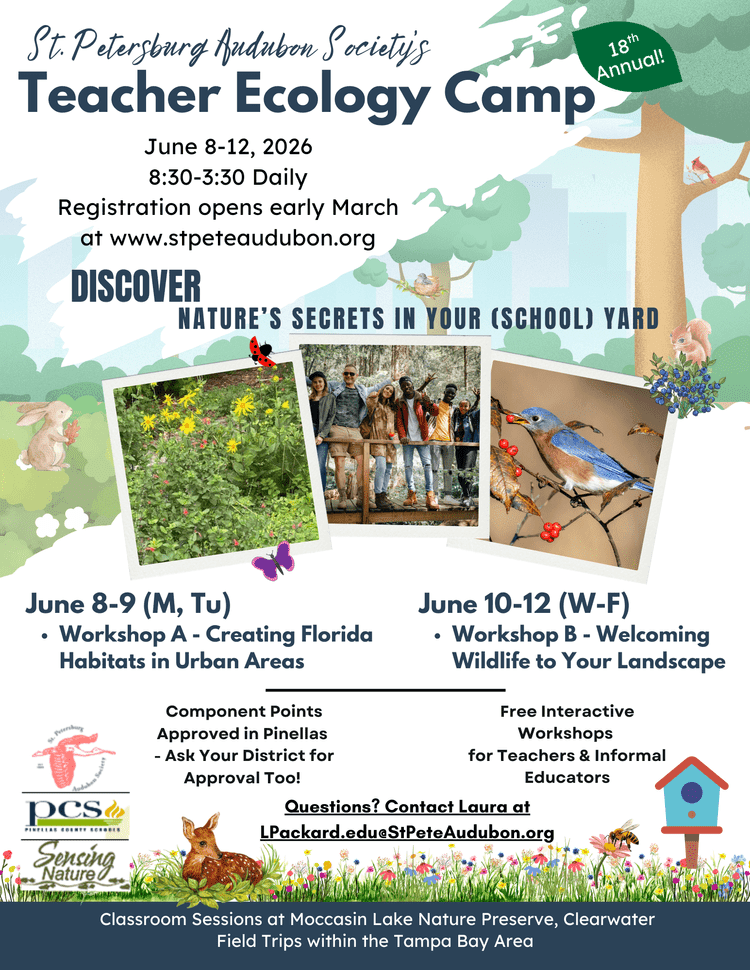
The vision of benefactor Dr. Harold Albers, Teacher Ecology Camp is a science camp for educators which combines presentations from the local scientific community with practical in-the-field experience. Teacher Ecology Camp is presented at no charge to educators in collaboration with Sensing Nature biologists & environmental educators, Jeanne Murphy and Brian Lane.
**Register here**
Learn more about Dr Harold Albers _________________________ |
|
Meetings | ConservationSPAS Annual Members Meeting | Tuesday, 9/15/26 | 7PM-9PM
Dessert social, speakers, vote on Board of Directors Audubon Florida Assembly | 10/15-17/26 | TradeWinds Resort, St Pete Beach
Protecting What Connects Us - Water, Wildlife, and Community _________________________
|
Sharing the Love of BirdsGlobal Big Day | Saturday October 10, 2026
October Global Big Day is an annual, worldwide birding event in which participants observe, count, and document as many bird species as possible during a single 24-hour period. Organized by the Cornell Lab of Ornithology, using the eBird and Merlin platforms, it has brought together hundreds of thousands of people from nearly 200 countries. This year, Tampa Audubon VP and Field Trip Director Mic McCarty has proposed organizing a friendly, inter-chapter competition, West Florida Global Big Day. Each chapter would compile and submit birding data collected by multiple teams of two or more individuals. Mic’s vision for this event is to “boost our visibility, recruit new members, potentially raise funds to support our chapters’ initiatives, and, most importantly, bring our community together for some memorable fun.” St Pete Audubon is planning to incorporate The Big Sit! participants as one of the teams. _________________________
|
SPAS Board NewsAhead of the SPAS Annual Members meeting in September, a committee has been formed to nominate Board candidates for the upcoming year.
Nominating Committee
Beth Forys, president_bethforys@stpeteaudubon.org
Susan Benson, susan.benson@stpeteauduon.org
John Ficken, john_ficken@stpeteaudubon.org
Current proposed slate of candidates
Beth Forys, President
Peter Plage, Vice-President & Director, Birds on the Move
Susan Benson, Second Vice-President
Abby McKay, Secretary
Eve Waterman, Treasurer
Julia Gallagher, Director, Social Media
John Ficken, Director, Membership
Laura Packard, Director, Teacher Ecology Camp
Lisa Reich, Director, Conservation
Francesca Di Cosmo, Director, Field Trips
Gale Raichart, Assistant Director, Field Trips
Tracey Grimm, Director, Education
Emily Ashe, Director, Programs and Events
Donna Sperber, Wingspan Newsletter Editor
Open position
Student chair Suggestions for nominations for any of these positions may be proposed to the Nominating Committee by any member of SPAS. _________________________
|
|
|
|